


Unique Disability ID - UDID Card
The UDID Card is a Unique Disability ID issued by the Department of Empowerment of Persons with Disabilities under the Ministry of Social Justice and Empowerment. It serves as a single identity card for persons with disabilities, helping them access benefits and services, and contains a unique ID number along with personal and disability details.
As of 2026, 1.33 crore of cards have been issued nationwide, which helps beneficiaries to easily access government schemes, reservations, and services. It replaces multiple disability certificates with a single card which works across the country.
Table of Contents
- Key Points of the UDID Card Certificate
- What is a UDID Card?
- Types of UDID Card
- Objectives of UDID Card
- Features and Benefits of UDID Card
- Eligibility Criteria for UDID Card
- Documents required for UDID Card
- How to Apply for a UDID Card?
- How to Download your E-UDID Card
- How to Track the Application Status of UDID Card?
- Contact Details and Helpline Number for UDID Card

Key Points of the UDID Card Certificate
Name of the scheme | UDID Card |
Launched By | Indian Government |
Beneficiary | Disable Individuals |
Objective | To create a database of every disabled person |
Official Website |
What is a UDID Card?
A UDID (Unique Disability ID) Card is issued by Government of India which act as an official identification card for persons with disabilities.
This universally recognized document provides them with a unique ID number and a standardized digital record of their disability details. The card is designed to help disable in easily availing government benefits, schemes, and services across the country by replacing multiple disability certificates.
Types of UDID Card
There are three types of UDID cards. They are as follows:
- White Card: This card is issued if the if the beneficiary’s disability is below 40%
- Yellow Card: This card is issued if the if the beneficiary’s disability is above 40% but on or below 80%
- Blue Card: This card is issued if the if the beneficiary’s disability is above 80%
Objectives of UDID Card
The objectives of UDID Card are given below:
- Maintaining a national database of people with disabilities and providing each person with a special disability identity card.
- To promote openness, effectiveness, and simplicity in the distribution of various government benefits to people with disabilities.
- The card will also make it easier to monitor beneficiaries' overall financial and physical development.
- The database would assist the government in creating and implementing a variety of programs for people with impairments.
- This card will be functional throughout India.
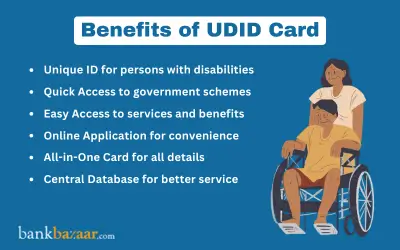
Features and Benefits of UDID Card
The features and benefits of UDID Card are given below:
- Unique identification: The UDID Card provides a unique identification number to each person with disabilities, ensuring a distinct and individualized record.
- Disability information: The card includes specific details about the type and extent of disability, offering a standardised and clear record for authorities and service providers.
- Accessible services: The UDID Card facilitates easier access to a range of government and non-government services and benefits intended for persons with disabilities.
- Online registration: Individuals with disabilities can register for the UDID Card online, streamlining the application process and making it more accessible.
- Centralised database: The initiative aims to create a centralised database of persons with disabilities, promoting efficient and targeted service delivery.
- Easy access to government schemes: Having a UDID Card ensures that individuals with disabilities can readily avail themselves of various benefits, concessions, and entitlements provided by the government.
- Authentication Tool: The UDID Card serves as a reliable authentication tool, aiding in the verification of disability-related information when accessing services or benefits.
- All information at one place: Now, individuals with disabilities do not need to produce numerous copies of various documents, keep them, or carry them because this card will collect all the relevant information and may be decoded by a reader.
- Support for people with disabilities: By providing a uniform identification mechanism, the UDID Card contributes to creating an inclusive environment and fostering support for persons with disabilities. The beneficiary's overall financial and physical development will be monitored with the use of this card.
Eligibility Criteria for UDID Card
The persons who are recognized under the Rights of Persons with Disabilities Act, 2016 are eligible to get a UDID card. The list of disabilities is as follows:
- Blindness:
A condition where a person has:
- Total absence of sight, or
- Visual acuity not better than 6/60 or 20/200 (Snellen) in the better eye with corrective lenses, or
- Limitation of the field of vision to 20 degrees or less.
- Low Vision: A person with impaired vision even after standard treatment, who uses or may use vision with assistive devices to perform activities.
- Mental Retardation: A condition of arrested or incomplete mental development, marked by below-average intelligence.
- Cerebral Palsy: A group of non-progressive conditions involving abnormal posture or motor control due to brain damage during pregnancy, birth, or early childhood.
- Hearing Impairment: Hearing loss of 60 decibels or more in the better ear within speech frequency range.
- Leprosy-Cured:
A person cured of leprosy but with:
- Loss of sensation in hands/feet or eyes/eyelids without visible deformity, or
- Visible deformity and paresis but still able to work, or
- Severe deformity and advanced age preventing gainful employment.
- Mental Illness: Any mental disorder other than mental retardation.
- Locomotor Disability: Disability of bones, joints, muscles, or cerebral palsy that substantially restricts movement of limbs.
- Acid Attack Victims
- Autism Spectrum Disorder
- Chronic Neurological Conditions
- Dwarfism
- Haemophilia
- Intellectual Disability
- Multiple Disabilities (including Deaf-Blindness)
- Multiple Sclerosis
- Muscular Dystrophy
- Parkinson’s Disease
- Sickle Cell Disease
- Specific Learning Disability
- Speech & Language Disability
- Thalassemia
Documents required for UDID Card
Generally, the following documents are to be submitted to apply for a UDID Card:
✔️ Aadhaar Card
✔️ Proof of Address
✔️ Caste Certificate (SC/ST/OBC)
✔️ Income Certificate (if applicable)
✔️Scanned copy of Disability Certificate (available only to people with disabilities for whom the appropriate authority has issued a certificate of disability)
How to Apply for a UDID Card?
Given below are the steps to apply for a UDID Card:
Step 1: Visit the official website of the Unique Disability ID.
Step 2: Click on the option ‘Apply for UDID’.
Step 3: Select the Aadhar e-KYC method.
Step 4: If you select ‘Apply with Aadhaar Number’, then fill in your Aadhar number, captcha code, and OTP that you get in your phone number.
Step 5: If you select the other option ‘Apply with Aadhaar Enrollment Number’, then you have to fill out the registration form.
Step 6: Upload the required documents and submit the form.
Step 7: You will get an Enrollment Number after submitting the form.
How to Download your E-UDID Card
Given below are the steps you will need to follow to download your E-UDID Card:
Step 1: Go to the official website of the Unique Disability ID.
Step 2: Log in by clicking on the option ‘PWD Login’
Step 3: Enter your enrollment number/ UDID number, Date of Birth, and captcha code.
Step 4: Click on the option ‘Log in’.
Step 5: Navigate to the ‘My Account’ section.
Step 6: Click on the option ‘Download your E-UDID Card’.
Note:*You can now also download the card by downloading the PWD app on your mobile phone.
How to Track the Application Status of UDID Card?
By following the steps given below, you can track the application status of UDID Card:
Step 1: Go to the official website of the Unique Disability ID.
Step 2: Click on the option ‘Track Your Application’.
Step 3: Select from the given options, i.e. UDID Number, Mobile Number, Enrollment Number, or Aadhaar Number.
Step 4: Fill in the number for the option you selected.
Step 5: Click on ‘Submit’ to check the status of your UDID Card.
Validity of UDID Card
There are two types of validity for UDID card: Permanent UDID card and Temporary UDID Card.
Permanent UDID: If there is no progress or regress in the disability of a beneficiary, this card is issued by the medical authority.
Temporary UDID: If there is a progress or a regress in the disability of a beneficiary, this card is issued by the medical authority.
Contact Details and Helpline Number for UDID Card
In case you face any issue related to UDID card application, registration, or status tracking, you can contact the UDID support team using the details provided below:
✅ Address -
Shri Vineet Singhal, Director
Department of Empowerment of Persons with Disabilities, Ministry of Social Justice & Empowerment
Room No. 517, B-II Block, Antyodaya Bhawan, CGO Complex, Lodhi Road, New Delhi - 110003
✅ Helpline Number - 011-24365019
✅ WhatsApp Number - 91-93549-39703
✅ Email Address - disability-udid@gov.in
- vikash.prasad@nic.in
✅ Toll-Free Number - 1800-110-708
FAQs on UDID Card
1.Can I use my UDID card to buy a train ticket?
For people with disabilities to book railway tickets at discounted rates on the IRCTC online or at reservation counters, they must have this card.
2.Can I use my UDID card anywhere in India?
Yes, the UDID card would be accepted throughout India as proof for people with disabilities.
3.Is a UDID card sent to my home?
The UDID cards will be mailed to the address provided during online registration.
4.How long does it take to obtain a UDID certificate?
The UDID card will be distributed within 10 to 15 days of registration.
5.Which government body introduced the UDID card?
The Department of Empowerment of Persons with Disabilities, Ministry of Social Justice & Empowerment, Government of India, introduced the UDID Project in 2016.
6.How long is a permanent UDID card valid?
When awarded to a disabled individual who is over the age of 18 years, the card has lifetime validity. The card must be updated once every five years for impaired children under the age of 18. If the handicap is permanent, no more medical testing is required.
7.How many characters are on the UDID card?
The UDID card contains 18 characters. They represent the state code (first two), district code (next two), CMO code (one), disability type (two), year of birth of the PwD (four), running number (six), and a final checksum digit for security.
8.How can I find out which hospital or medical authority has been given the task of assessing me?
On the receipt produced by the UDID portal, you can find information about the medical authority or hospital that was given to the PwD for assessment. The PwD has to go to the designated medical authority or hospital for the next step.
9.How will I find out when will I be asked to come for medical assessment?
The date of the assessment and the name of the hospital will be mentioned in an SMS sent to the PwD's mobile number. The PwD should speak with the relevant CMO of the district if they failed to include their mobile number in the UDID application.
10.After the issuance of my UDID card, will I receive a message with the speed post tracking number?
No, after the card has been sent out for delivery, the PwD must obtain their speed tracking number by visiting the UDID portal.
11.Which state and central government departments provide benefits to PwDs who possess UDID cards?
The concerned authorities responsible for providing benefits to PwD with UDID cards are the Social Welfare Department dealing with disability at the state level and the Department of Empowerment of Persons with Disabilities (Divyangjan) at the central level.
12.Is a PwD allowed to generate their UDID card in various states or districts?
PwDs are allowed to generate their UDID card from their resident district or at the government hospitals where they are receiving treatment.
13.Is UDID card linked to Digilocker?
Yes, UDID cards are linked to Digilocker.
14.Is Aadhaar a mandatory document to apply for a UDID card?
As of now, Aadhaar is not a mandatory document to apply for a UDID card.

Kankana Mukherjee is an engineer and has over 4.5 of experience in content writing. Combining the expertise in financial content writing achieved in her 2 years association with BankBazaar, and a knack for clear and engaging content, Kankana simplifies complex financial concepts and offers practical insights to help readers make informed decisions and achieve financial success.

Disclaimer
Credit Card:
Credit Score:
Personal Loan:
Home Loan:
Fixed Deposit:


Copyright © 2026 BankBazaar.com.